
Thinking Out Loud About the Industry I've Spent My Career In.
I spent 28 years inside one of the most complex product creation environments in the world. These are the perspectives that came out of that experience — on design, digital transformation, technology, and what it actually takes to build organizations that make great products consistently. No agenda. Just the thinking.
We've Made This Promise Before
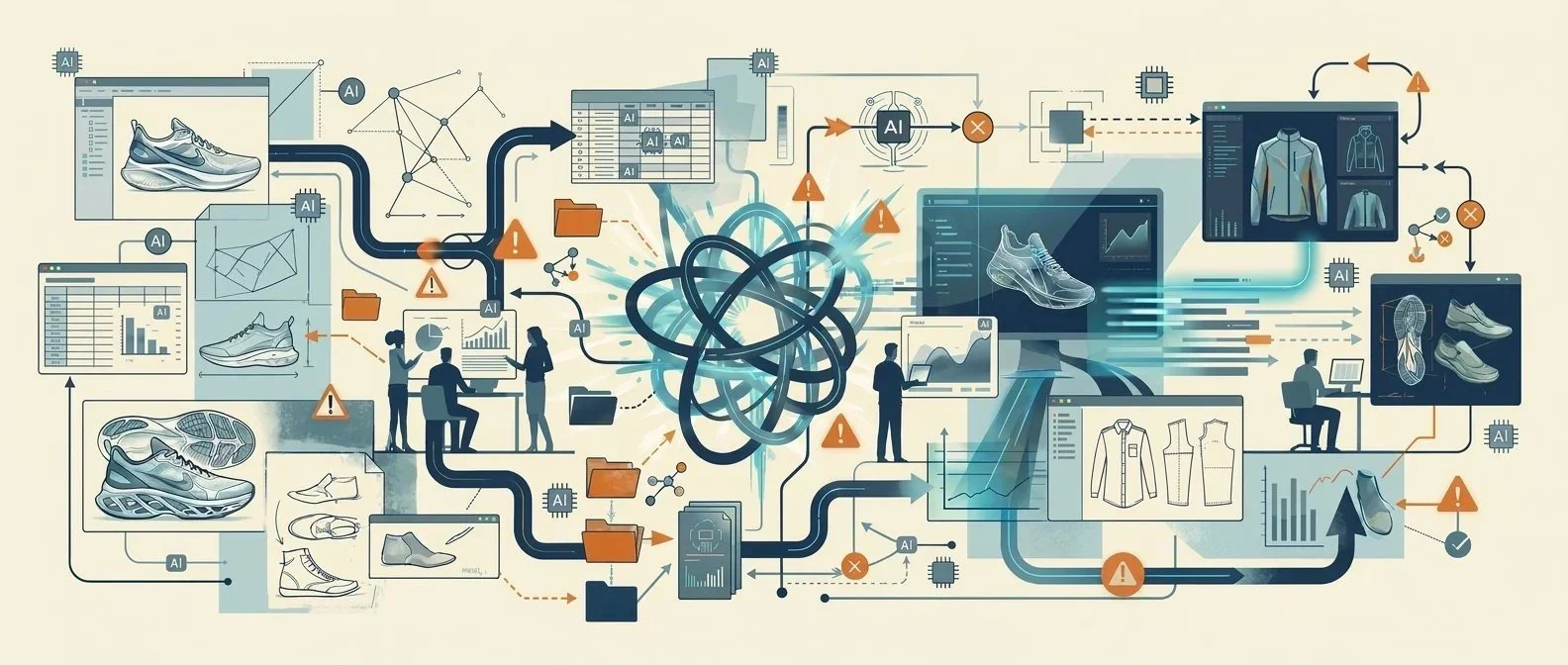
AI is being sold as the thing that finally takes the friction out of product creation. We made the same promise during Digital Product Creation—and it broke in the same place every time.
AI is being sold as the technology that will finally remove the friction from product creation: faster concepts, fewer rounds, less waste, shorter calendars. The promise is everywhere, and much of it is believable. I believed it about Digital Product Creation, too. The technology was real. The promise was reasonable. Yet after a decade of investment, many organizations found themselves asking why the results hadn't matched the expectations. The pattern was surprisingly consistent: A new technology arrives promising to remove friction. It gets deployed before anyone defines the friction it's supposed to remove—and ends up creating a new kind of friction instead. The technology usually isn't the problem. The problem is that we skip the one step that determines whether the technology will ever deliver on its promise. Let me show you the same story twice. First with the wave we've already lived through. Then with the one arriving now.
The wave we've already lived through: DPC
Digital Product Creation was the move to conceive, develop, and decide on product digitally instead of physically. It didn't arrive all at once. It came in layers, over years—and the same mistake repeated at every one.
It started with 3D. The case was clean: cut fewer physical samples, see the product earlier, take rounds out of the calendar. All of it was true. Then the tools went into teams, and a friction no one had budgeted for showed up. Brands ran 3D and physical in parallel, because nobody fully trusted the screen yet. Instead of replacing a step, they added one. A render got treated like a specification, and decisions got made on an image that was never built to carry them.
None of that was a flaw in the software. It was the cost of deploying a capability before anyone defined the problem it was there to solve.
Then the promise got bigger, and the friction grew with it. A "digital twin" was supposed to be the product itself, expressed in data. But ask ten people in a footwear company what a digital twin is and you'll get ten answers. The vendor means a high-fidelity render. The designer means a sampling replacement. The manufacturing director means a build specification. The CFO means cost reduction. None of them wrong. None of them describing the same thing—and all of them funding the same line item against a different picture of what they were buying.
Then came the full program, and it had the same shape every time. Tools bought separately that don't talk to each other, so the single source of truth becomes three. Retraining no one scoped. Ownership of the digital asset left undefined, so the physical process never actually goes away. And because the friction was never named at the start, no one could say at the end whether it had been removed—so programs that delivered real value still read as failures.
The pattern didn't run once. It ran at every layer. A decade of chances to learn the shape of it.
Here it is again.
The wave arriving now: AI
AI is the next wave, and it's following the same pattern—only faster.
Organizations know they should be using AI. Far fewer can clearly articulate where it creates value inside their product creation process. That gap—between knowing you need a technology and understanding which problem it should solve—is where friction begins.
I've heard two versions of the same story repeatedly from people still inside the industry.
The first is organizational. Teams are told to "use AI," but no one defines what success actually looks like. The technology becomes a mandate instead of a solution.
"Use AI" lands as a mandate, not a problem to solve.
The second is familiar to anyone who lived through the early days of 3D. Business teams know where work feels slow but struggle to describe the root cause. Technology teams understand the tools but can't translate vague frustrations into targeted solutions. The AI ends up sitting between the two groups, satisfying neither.
Imagine a footwear design team using generative AI to produce dozens of concept sketches in minutes. Design celebrates the speed. Product management assumes the concepts are ready for development. Engineering quickly discovers they ignore manufacturing constraints, material limitations, or costing realities. Instead of eliminating work, the organization creates another review cycle to separate inspiration from execution.
The AI worked exactly as designed.
The organization hadn't decided which decision it was supposed to accelerate.
Neither of these failures belongs to the technology. They're consequences of deploying a capability before defining the friction it exists to remove.
That's the same mistake we made with 3D. It's the same mistake we made with digital twins. AI is simply repeating the pattern on a much faster clock.
Buying technology feels like progress.
Defining organizational problems feels like work.
Too often, organizations choose the former and postpone the latter.
Breaking the pattern
The pattern has only ever broken one way: someone defined the friction before they bought the tool.
That's the intervention.
Before deploying a 3D capability, a digital twin program, or an AI platform, answer one question:
What specific friction is this investment supposed to remove?
Everything else follows from that answer.
"We're investing in AI" isn't a strategy. It's a budget line.
The organizations that succeeded with Digital Product Creation weren't necessarily the ones with the most advanced software. They were the ones that identified the decision they wanted to make faster, aligned around it, and could measure whether the investment actually improved it.
This is fundamentally a design operations challenge—not a technology purchase.
Naming the friction. Defining success. Establishing ownership. Determining the new source of truth. Preparing the organization before the tool arrives.
That's the work that determines whether any technology wave delivers lasting value.
Every wave promises speed.
The organizations that benefit most aren't the ones that adopt first.
They're the ones that know exactly which decision they're trying to make faster.
Technology doesn't remove friction.
People do—by deciding which friction matters before the technology ever arrives.
The Murky Middle: Representation, Translation, and the Real AI Opportunity in Product Creation
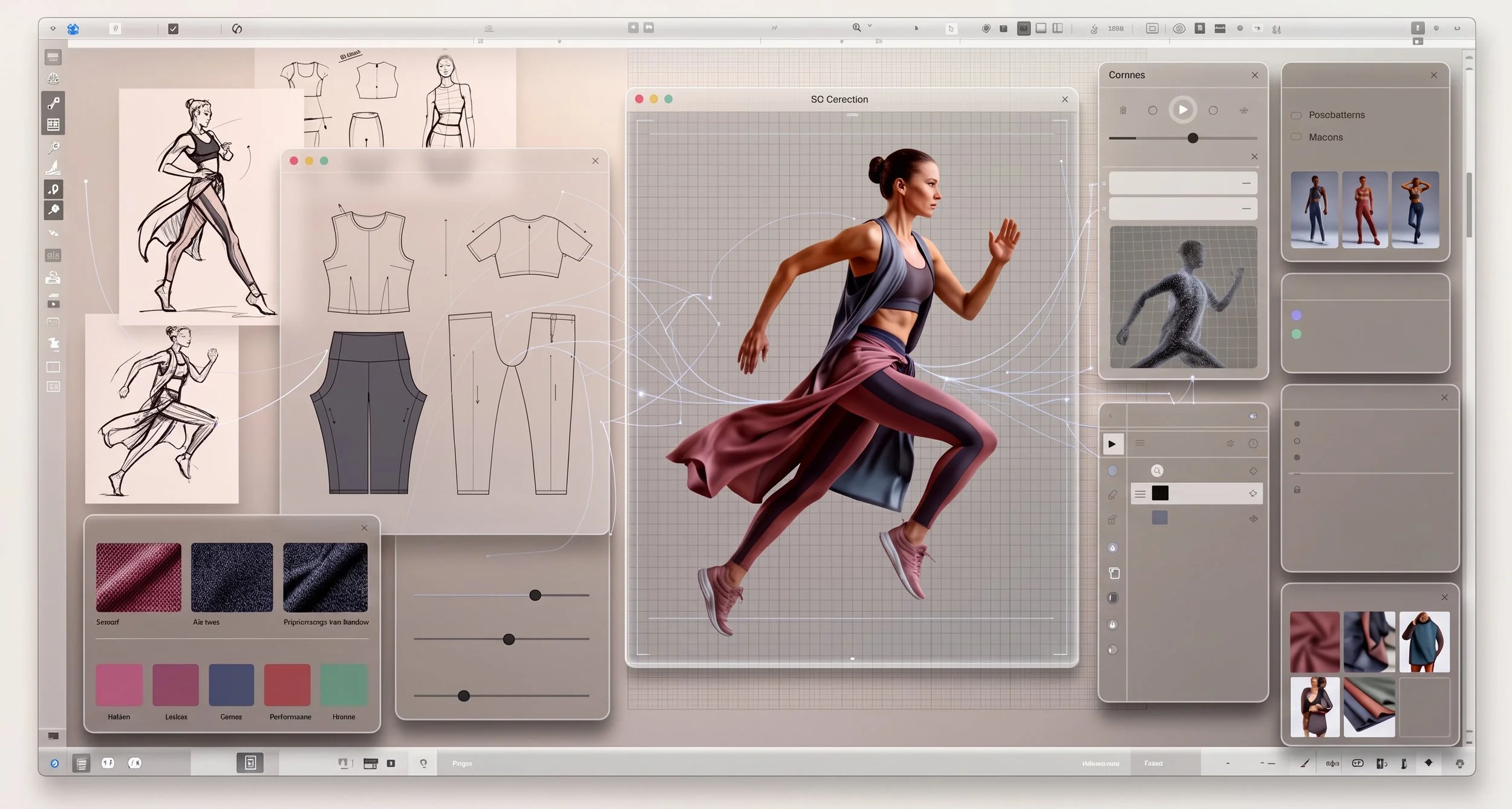
The visible AI wins in fashion are at the edges — concept generation on the front end, marketing imagery on the back. The middle of the pipeline, where a sketch becomes a pattern and a pattern becomes a simulated garment, is where the consequential decisions get made and where AI's potential is least understood. The real opportunity isn't AI learning to simulate fabric physics. It's the translation layer that lets an agent operate the engines that already do.
Everyone can see AI at the edges of product creation.
On the front end, generative tools are producing concept imagery at a speed and volume that would have been unthinkable three years ago. On the back end, virtual photoshoots and AI-generated marketing imagery are compressing timelines and budgets for e-commerce at scale. Those applications are visible, well understood, and — for the brands investing in them — already delivering measurable returns.
It’s the middle that’s murky.
The middle is where a sketch becomes a pattern. Where a pattern becomes a simulated garment. Where a 3D model needs to behave like the physical product it represents — materials that drape correctly, structures that hold up, constructions that can actually be manufactured. This is where the most consequential decisions in the product creation pipeline are made, where the technical demands are highest, and where AI’s potential is least understood. It’s also where I spent the latter part of my career at Nike, building the digital product creation infrastructure that sits between concept and commerce. The middle is where the real leverage is. And almost nobody is talking about it.
The Bookends Are Easy to See
The visible applications are attracting the visible investment. According to McKinsey and BoF’s State of Fashion 2026, over 48 percent of global fashion brands have integrated machine learning into collection planning and 3D sample generation. The AI fashion market was valued at $2.78 billion in 2025 and is growing at nearly 40 percent annually. Nike’s A.I.R. project used generative AI and 3D printing to co-create footwear designs with athletes, compressing concept-to-prototype timelines from weeks to hours. Adidas trained a diffusion model on its entire sneaker archive dating back to the 1950s to generate new concepts. On the other end, platforms like Vue.ai are producing on-model fashion imagery at a quarter of the cost and five times the speed of traditional photoshoots.
None of this is the hard part. Concept generation and marketing imagery are the lowest-risk applications because getting them wrong costs relatively little. A concept that doesn’t work gets discarded. A marketing image that misses the mark gets reshot. But in the middle of the pipeline, decisions carry downstream consequences that compound — a pattern that doesn’t work delays manufacturing, a simulation that doesn’t reflect material behavior leads to costly physical corrections, a 3D model that can’t translate to production engineering wastes weeks of work across multiple teams. The stakes are structurally different.
Representation vs. Simulation
For two years there was a race in fashion tech to go from prompt to 3D model. The results looked impressive on screen — visually compelling shapes you could turn in space, light from any angle, drop into a review meeting. But what those tools produced were solid mesh forms with no manufacturing utility. You couldn’t take them into pattern making. You couldn’t simulate fabric behavior on them. You couldn’t grade them, spec them, or hand them off to a factory. They existed in the space between concept and product, which is precisely where representation alone isn’t enough.
The race I’m describing isn’t over — it’s intensified. Open-source models like Microsoft’s TRELLIS.2 now produce watertight meshes with PBR materials in minutes, dramatically better than the demos of two years ago. For 3D printing and additive manufacturing, the outputs are usable. For pattern making, sample engineering, and production specs in soft goods, they still aren’t. Better meshes, same gap.
The story I’ve been telling for the last two years — AI is good at representation, AI can’t do simulation — is starting to get out of date. Not because the AI itself learned to simulate fabric physics. It didn’t. The simulation engines didn’t suddenly need it to. CLO3D, Style3D, Browzwear, Marvelous, Substance — those tools already handle the physics, and they’ve been handling it for years. The question was never whether the math was good enough. It was who or what was driving the app.
That’s the shift actually happening, and anyone working seriously inside a product creation pipeline right now can feel it. The agentic layer is moving in. Not as a replacement for the simulation engine, but as the operator of it. Sketch in, agent runs the pattern step, agent drives the simulation, agent hands the result to the next stage. None of the major platforms is going to publish a press release titled “agents are now operating our software end-to-end” — but if you’ve been in the rooms where the work is happening, you know roughly where every one of them is. Some of it’s public. Most of it isn’t. Style3D has been the most direct about positioning around an agentic layer. Adobe rebuilt its Substance 3D pipeline on OpenUSD and automation and pushed 55,000 renders in three months. The line between automation and agent is getting thinner by the week.
So the rep/sim binary is collapsing into something more useful. AI does representation natively. The simulation engines do simulation. The middle of the pipeline isn’t waiting on AI to learn fabric physics — it’s waiting on the orchestration layer that lets an agent drive the engines that already exist. That’s a translation problem.
The brands already operating this way are quietly pulling away. Tapestry trained Adobe Firefly on proprietary design elements they call “Coach codes” — brand-specific materials, hardware, construction details — so a digital twin stays on-brand from concept through marketing. That’s not a demo. That’s a production workflow where AI operates at the level of fidelity each stage demands. And what’s public is a small fraction of what’s actually happening inside these organizations. The real experimentation is below the waterline.
The Translation Layer
The most immediate AI opportunity in the middle isn’t full simulation. It’s translation.
Once you stop expecting AI to do the physics itself and start asking how an agent operates the engines that already do, the whole problem reframes. The question isn’t “can AI simulate a draping garment.” The question is “can AI take a sketch, prep the pattern, set up the simulation in the right tool, evaluate the result, and hand it off to the next stage.” That’s translation, end to end. And it’s exactly the kind of structured problem AI is already good at.
Every product creation pipeline has handoff points where work crosses from one system, one team, or one format to the next. Creative output needs to become engineering input. A sketch needs to become a pattern a designer can adjust in the software of their choice. A pattern needs to become a simulated garment without someone manually constructing every seam. In footwear, a sketch needs to become a procedural model — something editable and adjustable — and then transform into a real-time rendering that teams can evaluate together. These translation steps are where enormous amounts of time and fidelity get lost.
The numbers support this. Brands using digital twins and AI-assisted workflows report physical samples dropping from 15–25 per style to as few as 1–2, with pre-production costs falling 60 to 80 percent and development timelines compressing from 12–16 weeks to 2–4. Rendering time for a fully layered outfit dropped from five minutes in 2025 to under 90 seconds in 2026 using GPU-optimized AI pipelines. CLO3D reports 28–40 percent time savings in pattern-to-simulation workflows with AI-assisted features.
These gains come not from AI replacing the people in the middle, but from AI handling the translation between stages — converting formats, bridging systems, maintaining fidelity across handoffs — so that designers and technical developers can spend their time on the decisions that actually require human judgment. Translation is a tractable problem. Full simulation isn’t — not yet. The distinction matters because it changes what you build toward today.
The Human in the Loop
The industry has an underdeveloped understanding of how to use AI in stages alongside the people who provide oversight, quality control, and domain expertise. Most conversations about AI in product creation jump straight to capability — what AI can generate, how fast, at what resolution. Very few start with workflow design — at which step does AI contribute, at what level of fidelity, with what kind of human review at each gate, and who owns the decision when the AI output needs correction.
This is a design ops problem, and it’s the same one I argued in my last piece. The brands that built the operational foundation around 3D pulled ahead while others invested in tools they couldn’t actually deploy. AI in the middle of the pipeline is heading toward the same pattern. The talent bridge — the people fluent in both the creative process and the digital tools — is the connector between where AI is now and where it needs to go inside a working product creation pipeline. Eliminate that capability in a downturn and you don’t just lose what you built. You lose your best shot at what comes next.
AI doesn’t need to replace the people in the middle. It needs to work alongside them — in stages, with oversight, at increasing levels of fidelity. Build that workflow and the middle of the pipeline stops being murky. Leave it unbuilt and AI just becomes another tool that promised more than it delivered — not because it couldn’t, but because nobody designed the conditions for it to work.
Design Ops in Footwear and Fashion: What It Is, What Transfers, and Why Getting It Wrong Is Already Costing You
It All Begins Here
Most conversations about design ops start in the wrong place.
People reach for project management, resource scheduling, or process analysis and call it design operations. It’s none of those things. At its most precise, design ops is the discipline of designing the conditions under which creative and technical work happens — the workflows, calendars, gates, tools, team structures, and cultural norms that determine whether an organization can consistently convert creative ideas into market-ready products at speed and at scale. And embedded in all of that is something less talked about: a genuine understanding of creatives and the creative process. Done well, design ops isn’t just infrastructure — it’s an act of nurturing. You are creating the environment in which talent can do its best work, feel supported and challenged in equal measure, and have enough autonomy to pursue genuinely innovative solutions.
I held the role of Global Design Operations Director at Nike, spanning Footwear, Apparel, and Equipment. Before that I was a designer. After that I led digital product creation and 3D studio strategy. That arc — from making products, to running the operations behind making products, to transforming how products are made digitally — is why I care about getting the definition right. And the clearest signal that design ops is working is that it becomes invisible — it removes friction so completely that teams stop noticing it. When it fails, the opposite is true: everything feels harder than it should.
That distinction matters more than ever right now. The industry is at a point where significant investment has been made in design technology — 3D, digital product creation, AI — and the results are… uneven. For leading brands that built the operational foundation, AI tooling has moved from experimental to operational. For others, AI is arriving faster than they can absorb it — adding new capability, new complexity, and new pressure onto teams still finding their footing with the last wave of change. The conditions you create for your people matter more, not less, when the technology landscape is moving this fast.
The Transferability Trap
There is a version of this conversation where someone points to automotive or architecture as the benchmark — look how mature their design operations are, let’s import that here. And they’re not entirely wrong. There are first principles that transfer universally.
Decisions made early are cheaper than decisions made late. Digital tools need to be integrated into workflows, not bolted onto them. Asset governance and data infrastructure are foundational, not optional. Structured milestones protect creative exploration from premature engineering pressure. These truths hold whether you’re building a car, a building, or a boot.
But that’s where the direct transfer ends.
The three variables that separate industries operationally are timeline, volume, and complexity of variety. On all three, footwear and fashion sit at the opposite end of the spectrum from automotive and architecture. A car platform might run for seven years. A fashion season runs for months. Architecture manages one-off complexity inside long programs. Fashion manages high-mix, high-volume complexity inside a relentless annual calendar. The operational model that works in one context doesn’t survive contact with the other.
Gaming and VFX offer a more tempting comparison — both are digital-native and have built sophisticated pipelines for managing creative work at scale. But their final output is digital. There is no physical product, no factory, no materials lead time, no last-mile supply chain. The handoff that defines so much of fashion’s operational complexity simply doesn’t exist for them.
There’s a further layer of complexity that rarely gets named. When digital workflows enter footwear and fashion, they don’t replace the physical process — they run alongside it. Other industries are navigating this too — automotive and architecture are increasingly leveraging the same real-time visualization platforms that power gaming pipelines. But they’re doing it with longer timelines and far fewer SKUs. In footwear and fashion, the hybrid physical-digital pipeline has to operate at the same relentless speed and scale as everything else. That’s what makes the operational challenge structurally different — and why no existing model transfers cleanly.
Design ops in footwear and fashion has to be built for footwear and fashion — adapted to the industry, and then calibrated further to the size, scale, and specific business objectives of each organization.
What Good Actually Looks Like
The brands making the most meaningful progress share a consistent pattern. They embedded operational capability at team level rather than deploying it as an initiative from above. Where process becomes the way of working, it sticks. Where it remains a program owned centrally and visited periodically, it doesn’t.
Operational roles can be genuinely valuable in this — raising issues, managing risk, facilitating alignment, maintaining momentum. But they work best when they’re running alongside the people doing the work, not observing from a distance. That proximity matters. It allows ops to understand the work at a deeper level, to see the whole field of play and not just their own responsibilities — and from that vantage point, to plan better, predict problems earlier, and help teams maneuver when things shift. Ops doesn’t need to be the enforcer. But the metrics and signals they surface need leaders who will act on them. Without that, ops becomes a reporting function nobody responds to.
The other consistent differentiator is how technology sits relative to product teams. The brands that have placed technical capability close to — or inside — the product teams move faster and adapt better. Those keeping technology at arm’s length spend enormous energy on translation, and the translation always costs time and fidelity.
Leadership immersion matters too, and it’s underappreciated. Research consistently shows that nearly half of employees in digital transformation programs don’t feel adequately prepared — and that gap almost always traces back to leadership that endorsed the direction without genuinely understanding the work. The brands making real progress have leaders who are in it, not just behind it.
The Failure Modes That Repeat
Despite genuine progress across parts of the industry, the same breakdowns appear with regularity.
Cross-functional alignment is the most common. Design ops that functions well inside the design team frequently collapses the moment it hits the handoff to development, sourcing, or manufacturing. Part of the problem is structural — some functions have mature ops capability, others have none at all, and when the process moves between them it loses coherence. Ops functions that span organizational boundaries rather than sitting inside a single function can help here, providing the connective tissue that keeps the end-to-end pipeline readable and accountable.
Data governance is a failure that runs the full length of the pipeline. Design and BOM data created early in the process becomes disconnected from what follows. Designers struggle to find the reference data they need for their own work. And for the teams who depend on that data downstream, it can be a black hole — assets that exist but can’t be found, versioned, or reused at scale because the underlying infrastructure was never built. The work happens; the knowledge doesn’t accumulate. It’s the same failure at every stage, showing up differently depending on where you sit.
Change management is arguably the most honest gap in the industry — and one of the most under resourced. New tools and new processes get deployed without giving teams the time and genuine support to adopt them. This is not a people problem — it’s a planning problem. Dedicated change management roles are critical during any significant transition, and they tend to work best when partnered closely with ops — one focused on moving people through the change, the other on keeping the operational picture clear throughout it. The industry moves fast enough that carving out space for this is hard. But the brands that don’t make that space pay for it in slow adoption, low confidence, and capability that never fully lands.
The Scaling Back Moment
Over the past two years, a pattern has played out across the industry. Organizations — including significant ones that had been treated as lighthouses — scaled back their DPC strategies. In some cases, entire 3D design departments were reduced or eliminated. The common reading was that the technology didn’t work. That reading was wrong then, and the evidence since has confirmed it.
Most of these weren’t technology failures. They were design ops failures. The tools had matured significantly — the problem was that the operational infrastructure required to deploy them effectively was never built alongside them. No clear workflows. No data governance. No change management. No cross-functional alignment beyond the design team. When the investment was made in the tool but not in the conditions that make the tool valuable, the ROI was always going to disappoint. That’s a design ops problem, not a 3D problem.
The resolution of that period is now becoming clearer, and it tells the same story from a different angle. Many of the brands that “scaled back” were actually right-sizing — moving from deploying 3D everywhere to deploying it where it creates the most value. That’s organizational learning, not failure. The brands that are in genuine trouble are the ones that discarded the capability entirely rather than asking the harder question: did we actually build the operational foundation this required?
The talent question is where this gets most costly. The people who understand both the creative process and the digital tools are rare, developed over years, and not easily rebuilt. Disbanding those teams in a downturn means starting again from scratch in the upturn — at significant cost and with significant delay. And there’s a compounding risk that rarely gets named: these are the same people who would be driving AI adoption into the design process. The designers and operators fluent in digital tools are the natural bridge between where AI is now and where it needs to go inside a product creation workflow. Eliminate that capability and you don’t just lose what you built — you lose your best shot at what comes next. That’s a risk that doesn’t always make it into the cost-cutting analysis.
Where This Is Going
The discipline of design ops becomes more important the more complex the technology landscape gets — and for the brands treating it as a strategic capability rather than a support function, the picture looks different. The operationalization of digital creation in footwear and fashion is progressing, but unevenly. The brands that have built the operational foundation are pulling ahead. The gap between them and those still treating DPC as a project with an endpoint is widening.
AI is adding both opportunity and complexity to this picture simultaneously. More tools, more outputs, and — for anyone thinking clearly — significantly more governance challenges. The regulatory and IP landscape around AI-generated design has shifted from largely undefined to rapidly solidifying. USPTO revised its inventorship guidance for AI-assisted work in 2025. The Copyright Office published its analysis of AI and training data. Congress introduced the NO FAKES Act. The rules are no longer unclear — they’re tightening faster than most organizations anticipated. Brands that haven’t built data governance infrastructure will find AI compounds that weakness rather than solving it.
Design ops exists precisely to absorb that complexity so that creative and technical teams don’t have to carry it themselves. The brands that treat it as a strategic capability will be the ones that realize the full value of their digital investment. The ones that don’t will keep wondering why the tools aren’t delivering what they promised.
The tools were never the problem.